In a breakthrough study, Israeli scientists say they have developed a novel deep brain stimulation approach for patients with schizophrenia.
This therapy for the severe chronic mental disorder could restore functions that control movement, learning and decision-making.
“The study proposes a new therapeutic direction, which may in the future expand the treatment options for patients with schizophrenia who do not respond sufficiently to existing treatments,” said Dr. Nir Asch, a doctor and researcher in the psychiatric department of Rambam Health Care Campus in Haifa.
Asch led the peer-reviewed research, which leveraged computational modeling, data analysis and machine learning, and appeared in the scientific journal Nature Communications. The work was conducted under the guidance of 2024 Israel Prize laureate Prof. Hagai Bergman, a neuroscientist from the Hebrew University of Jerusalem and a pioneer of deep brain stimulation, which is also known by its acronym, DBS, for Parkinson’s disease.
“A problem we have with many psychiatric diseases is that we define them by the symptoms,” Asch, 44, told The Times of Israel. “In our paper, we provide a clear theory about what is happening on a mechanical level in the brain, and also a way to solve it.”
According to Ozma, an Israeli mental health organization, there are about 70,000 people with schizophrenia in Israel — or roughly one in 143 people.
“Why should we care about schizophrenia?” Asch asked out loud and then answered his own question.
“The World Health Organization says that 21 million people around the world have schizophrenia,” he said. “One-third of these are what we call treatment resistant. This is a big burden. So, I think that we should care.”
Schizophrenia’s distressing impact
Schizophrenia is a severe mental disorder that usually starts when people are in their early 20s and most often becomes a lifelong condition.
Symptoms can include hallucinations, such as hearing and seeing things that are not there, and persistent delusions, in which people insist on something that is not true, or claim that their thoughts and actions are being controlled by outside forces.
Other symptoms include disorganized thinking and speech, bizarre behavior and social withdrawal. It causes functional and occupational impairments, as well as social and family stigma.
The condition often impairs cognitive skills like memory and attention, making daily life and problem-solving exceptionally difficult.
Moreover, people with schizophrenia die nine years earlier than the general population, according to the World Health Organization. This is often due to physical illnesses, such as diabetes.
To understand schizophrenia, Asch said it’s important to first understand how the brain works.
“Basically, the brain is a prediction machine,” Asch explained. “It tries to predict what will happen. It builds a model. It asks, ‘What is the situation? What is happening around me?’ Then it receives the evidence from the world through the senses.”
In schizophrenia, this process breaks down. Patients suffer from “cognitive inflexibility,” finding it “extremely difficult to change their internal model even when the world around them changes.”
“They are kind of stuck in their own model,” Asch said. “The input is there, but they don’t relate.”
“This cognitive inflexibility is one of the hallmarks of the disease,” Asch said. “It’s very hard for them to understand that something has changed in the world. They’re stuck with hallucinations and delusions, without any input from the world.”
The network that helps the brain make choices
Asch’s research focused on the effect of DBS on two female African green monkeys.
In a controlled lab setting, they gave the monkeys phencyclidine, also known as “angel dust” or PCP, an anesthetic drug that can cause hallucinations, dissociations and “induces a psychotic state, which is exactly what happens in schizophrenia,” Asch said.
“Their cognitive flexibility was reduced significantly, and their random exploration, their chaotic behavior, increased significantly,” he said.
The scientists then zeroed in on the area of the brain known as the globus pallidus externus (GPe), a region that Asch described as a “gateway” for the brain’s decision-making process.
The GPe is part of what is called the basal ganglia–dorsolateral prefrontal cortex network, or the BG–DLPFC network.
This network connects the basal ganglia, which help control habits, movement, and decision-making, with the dorsolateral prefrontal cortex, which helps the brain make choices, learn from experience, and adapt to new situations.
Cognitive inflexibility cured
The GPe acts like a “dynamic valve” or filter in the network. When communication in this network is disrupted, it leads to confused thinking.
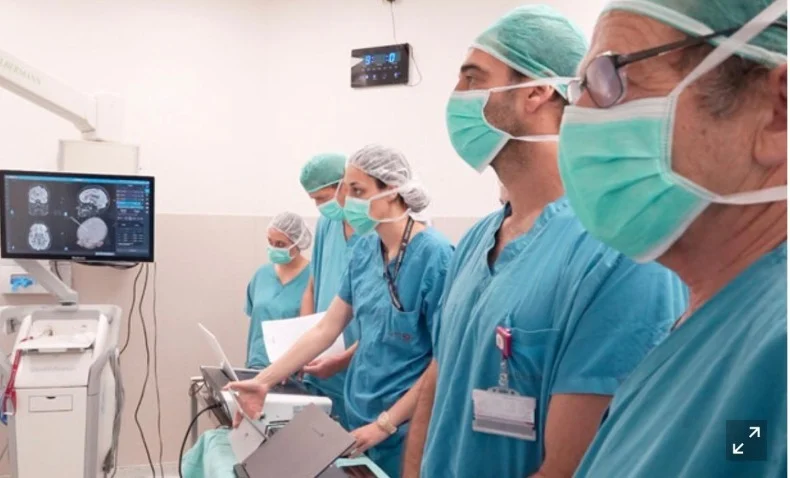
However, when the scientists applied DBS, or targeted, low-frequency electrical stimulation of 13 Hz, to this brain area, the results were immediate.
“The cognitive inflexibility was cured,” Asch noted. “The monkeys returned to the levels of when they were healthy, and they were also much less chaotic.”
The tested hypothesis was based on Bergman’s discovery that stimulating certain areas of the brain could alleviate the symptoms of Parkinson’s disease.
“Prof. Bergman is hands down the number one person in the world in deep brain stimulation,” Asch said. “I’ve worked on this project for 10 years, but this project has been worked on for many years before.”
Part of ‘hundreds of decision-making moments’
“Cognitive flexibility is a key feature in our everyday living, as part of hundreds of decision-making moments we experience every day,” said Dr. Idit Tamir, director of the functional neurosurgery unit at Rabin Medical Center, who was not involved with the study.
She said that “in the clinic and the operating theatre, we already see improvement in cognitive flexibility with deep brain stimulation to the basal ganglia in different patient populations, including those with Parkinson’s and obsessive compulsive disorder.”
Asch said the next step in the research will be a clinical trial in humans.
“Because the study was successfully performed on non-human primates, whose brains are remarkably similar to those of humans, we’re already meeting to discuss the best way to move forward,” he said.
He also noted that his perspective has changed since going from full-time research to treating patients in Rambam’s psychiatric department.
“When I did the research, I was very much interested in understanding the science,” he said. “But now, seeing the patients and witnessing the burden on their families gives me a lot of motivation to take it to the next step.”
“It can be very frustrating as a doctor when we don’t have great treatments,” Asch said. “If we can add more tools that are effective and pave the way to recovery, then it would be so wonderful.”